


A3 (c. 16"x12") print on:
Permajet Gold Silk (£26)
Innova Soft-textured matt (£24)
A2 (c. 23"x16") print on:
Permajet Gold Silk (£40)
Innova Soft-textured matt (£36)
Permajet Gold Silk (£40)
Innova Soft-textured matt (£36)


framing suggestion:

A3 (c. 16"x12") print on:
Permajet Gold Silk (£26)
Innova Soft-textured matt (£24)
A2 (c. 23"x16") print on:
Permajet Gold Silk (£40)
Innova Soft-textured matt (£36)
Permajet Gold Silk (£40)
Innova Soft-textured matt (£36)
St Andrew's,
Walberswick, Suffolk

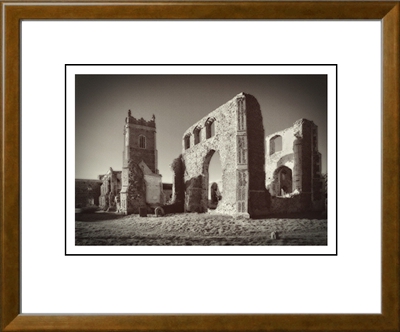
The tower of St Andrew's in Walberswick, a popular town on the Suffolk coast, is a 1426 AD construction built amid the remains of an earlier church, said to have possibly dated back to the era of the Doomsday Book. It nestles today amid the remains of the third church to have built on this site, completed in 1493. By the 16th century, both town and church had lapsed into decay. Visit the great church, not far away, at Blythburgh to know what St Andrew's would have been like in it's heyday - they were very similar. But go to Blythburgh anyway, if only for its magnificent roof and hammerbeams.
The calotype process, which this picture seeks to emulate, is not quite so old, having been developed (pardon the pun) by the early photographic pioneer William Henry Fox-Talbot in the 1840s, exposing directly onto paper coated with silver chloride (or nitrate) and processed in gallic acid. The improved sensitivity of this method reduced exposure time in the camera from hours to minutes. Positive prints could then be produced repeatedly by contact printing from the camera 'negative' - a great step forward.
The calotype process, which this picture seeks to emulate, is not quite so old, having been developed (pardon the pun) by the early photographic pioneer William Henry Fox-Talbot in the 1840s, exposing directly onto paper coated with silver chloride (or nitrate) and processed in gallic acid. The improved sensitivity of this method reduced exposure time in the camera from hours to minutes. Positive prints could then be produced repeatedly by contact printing from the camera 'negative' - a great step forward.